 Morcem® Cal Estructural
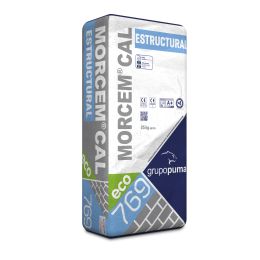
Natural hydraulic lime NHL 5 fibre-reinforced masonry and rendering mortar for reinforced render and masonry infill. Natural composition, permeable to water vapour. High mechanical strength.
Additional information
Technical Characteristics
Product based on natural hydraulic lime, pozzolan, fibres, selected aggregates and other additives. Contains no cement.
Advantages and Uses
• Breathable internal and external render for new or existing walls.
• For reinforced renders intended for reconstruction and infill in the refurbishment of masonry or brickwork.
• Suitable for refurbishment due to its high compatibility with traditional systems.
• High, progressively developing mechanical strength.
• Fibre-reinforced.
• For indoor and outdoor application in new-build construction where improved living conditions are required compared with cement-based mortars.
• Highly permeable to water vapour, allowing the substrate to breathe.
• Manual and mechanical application.
Uses
• Dampen the substrate and wait until the surface sheen has disappeared before starting application.
• On very irregular substrates or substrates with different absorption levels, it is advisable to apply a preliminary bonding spatter coat approximately 5 mm thick using the same product.
• For large surfaces, the use of mortar spraying machines is recommended. Start application from the base of the surface.
• For reinforced renders or masonry, drill the holes for the anchors used to fix the reinforcement mesh. These must be drilled into structurally stable areas of the wall. Install the mesh with overlaps of at least 15 cm between sheets. The mesh must be kept away from the substrate and embedded in the mortar.
• Start mixing the product using 3,75-4,0 litres of water per 25 kg bag. Continue mixing until a homogeneous, consistent and workable mix is obtained. Avoid excess mixing water; do not exceed 4,25 litres of water per 25 kg bag of mortar. Mechanical mixing is recommended.
• Apply a first coat of product between 10 and 20 mm thick, embedding the mesh in it. Allow the first coat to dry before applying subsequent coats at a thickness of between 10 and 20 mm.
• Leave a rough surface between coats to improve intercoat adhesion.
• Wait until the final coat has partially hardened before finishing with a float. During adverse weather, high temperatures or on very porous substrates, it is advisable to protect the surface with geotextile or damp hessian to reduce the rate of evaporation of the mixing water. The material may also be cured by spraying with water during the 24 hours after application.
• Before finishing with MORCEM® CAL coatings, wait 24-48 h per centimetre of applied thickness. For multi-coat applications, always dampen the surfaces and previously applied mortars when the underlying coats have hardened.
Suitable Substrates
• Conventional substrates based on hydraulic binders, brick or stone.
• Substrates must be strong, stable, sound and clean, free from dust, traces of release agents, organic products, etc.
• Remove any unsound or poorly cohesive areas of the substrate. Remove loose parts of the masonry and rebuild with the same mortar. To improve render adhesion, joints between masonry units should be recessed. Avoid the use of cement-containing mortars to prevent the appearance of salts or their introduction into the masonry.
• Where substrates have soluble salts or surface efflorescence, wash with low-pressure water to remove them. Repeat the procedure if necessary and assess treatment with a suitable primer.
• On porous substrates, thoroughly dampen the substrate and wait until the surface water film has disappeared before application.
• On low-porosity substrates, apply a primer (IMPLAFIX) or increase roughness by mechanical means.
• On weak substrates, assess the application of primer (FIJAMOR) to consolidate the surface and prevent dust formation.
• Do not apply over gypsum or paint.
Recommendations
• Do not apply below 5ºC or above 30ºC.
• Do not apply where there is a risk of frost, rain, strong winds or direct sunlight.
• It is advisable to gently spray the product with water on the day after application.
• Remove dust, dirt and efflorescence from the wall.
• Thoroughly dampen the substrate.
• Applying successive coats over damp mortar ensures good adhesion and facilitates carbonation.
• Adjust the mixing water, avoiding excess, and allow the required consistency to develop through mixing (3-5 min). Do not add water to already mixed mortar to restore workability.
• Substrates affected by damp must be treated beforehand. Assess the use of Morcem® Cal Porógeno dehumidifying mortar and take the necessary precautions to prevent rising damp in the surface and the applied mortar.
• For weak substrates, assess the installation of anchors to secure the mesh.
Packaging and Storage
25 kg plastic-lined paper bags.
Store for up to 1 year in the original sealed packaging, protected from weather and moisture.
Technical data
(Statistical results obtained under standard conditions)
| Appearance | Beige powder |
| Mixed product density | 2,10 ± 0,2 g/cm3 |
| Water vapour permeability | µ ≤ 15 |
| Classification according to UNE EN 998-1 | GP CSIV W2 |
| Classification according to UNE EN 998-2 | G |
| Compressive strength at 28 days | ≥ 7,5 N/mm2 |
| Compressive strength at 56 days | ≥ 10,0 N/mm2 |
| Compressive strength at 90 days | ≥ 12,0 N/mm2 |
| Adhesion | ≥ 0,3 N/mm2 |
| Capillarity | ≤ 0,2 kg/cm2•min0,5 |
| Sulphate resistance (90 d., 50 g/l SO3Mg solution) | No loss |
| Approximate coverage | 17-19 kg/m2 per cm of thickness |
Notas
The instructions for use are given according to our tests and knowledge and do not imply any commitment by GRUPO PUMA nor free the consumer from the examination and verification of the products for their correct use. Claims must be accompanied by the original packaging to allow a proper traceability.
GRUPO PUMA is not responsible, in any case, for the application of its products or constructive solutions carried out by the application company or other parties involved in the process and / or execution of the work, limiting the responsibility of GRUPO PUMA exclusively to the damages directly attributable to the supplied products, individually or integrated in systems, due to failures in their manufacturing process.
In any case, the drafter of the work project, the technical management or the person responsible for the work, or collaterally the application company or other parties involved in the process and / or execution of the work, must ensure the suitability of the products addressing the characteristics of them, as well as the conditions, support and possible pathologies of the work in question.
The values obtained by GRUPO PUMAS's products or its constructive solutions that, as the case may be, are determined by the EN standards or any other regulation that applies to it in each case refers exclusively to the conditions specifically stipulated in said regulation and that are referred to, among others, to certain characteristics of the support, humidity and temperature conditions, etc. without being them required in the tests obtained under different conditions, all in accordance with the relevant regulation.