 Pegoland® Porcelánico C1 TE
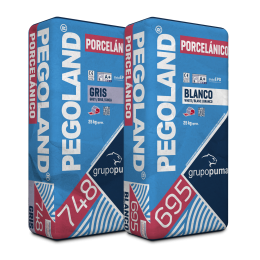
Cement-based adhesive with mixed binders, featuring reduced slip and extended open time, with excellent initial adhesion. It allows the adhesion of all types of ceramic tiles, porcelain stoneware, marble, granite, and natural stone on interior floors, exterior floors, and interior walls.




Additional information
Technical Characteristics
High-resistance cement-based product, with selected aggregates, additives and synthetic resins that guarantee high bond strength, excellent workability, and resistance to ageing.
Advantages and Uses
- Reduced slip. Excellent initial adhesion.
- Long open time, it allows the rectification of pieces.
- Due to its water retention power, there is no need to moisten the substrate.
- Adhesion of all types of ceramic pieces, porcelain stoneware, marble, granite, and natural stone.
- Suitable for interior and exterior use.
- Swimming pool renders with glassy mosaics.
Suitable Substrates
- Conventional cement-base substrates.
- Suitable for all type of drywall partitions (PYL type). Do not apply on top of paint.
- Substrates must be resistant enough, stable, sound, and clean. Free of dust, release agents, organic products, etc.
- All substrates should have adequate flatness. If this is not the case, make screeds of up to 5 mm with the same product 48 hours before gluing. For a greater thickness apply:
- On bonded screeds: Apply levelling paste NIVELAND 10R or PAVILAND RECRECIDO AUTONIVELANTE depending on the substrate and requirements.
- On walls: Use regularization mortars with adequate tensile strength and with a curing shrinkage already completed.
- In case of heavy heat, wind, or very absorbent substrates, it is advisable to moisten the substrate and wait until the water film is totally absorbed.
- In exterior floors, the substrate must have a slope equal or greater than 1%.
- Do not apply on top of gypsum, plaster, anhydrite, or any other substrates with high content of sulphates, or in contact with water or moisten with high content of sulphates.
- All substrates must comply with the specifications outlined in section 6.4 of UNE 138002 standard.
Application Procedure
- Add water and mix manually or mechanically until getting a homogeneous consistence, easy to work with. Let the paste rest around 5 min. then mix again.
- Spread the kneaded product on the substrate with the help of a trowel on a maximum extension of 2m2.
- Comb the area with a notched trowel to level the thickness (check table).
- Place the tiles on the fresh adhesive, pressing and moving them until getting a complete smashing of the grooves and the proper adhesion of all the ceramic surface. Periodically check the stickiness of the adhesive by lifting a previously laid tile, if the appearance of a film without transfer on the surface of the adhesive or dehydration of the adhesive is observed, proceed to remove the material and apply a new product.
- Laying of tiles by back buttering method outdoors, for tiles with superior to 45 cm side, if levelling systems are used or if the tiles have a relief that may interfere the gluing process.
- Respect the placement joints between tiles as indicated in section 7.7 of UNE 138002 standard. For interior and pool areas, the joint width should be ≥ (1.5 - 3) mm, and for exterior areas, the joint width should be ≥ (3 - 5) mm, depending on the type of installation and the larger side of the tile being placed.
- Joints should be refilled after 24 hours in walls and 48 hours after in floors. Use a suitable mortar from the MORCEMCOLOR range, considering the type of joint.
NOTE: The shorter the time between combing and laying the tile, the better results will be obtained.
Notched-trowel panel
Maximum tiles weight on walls: 40 kg/m2
| Type of tiles | Longer side cm | Trowel for adhesive application to the substrate | Trowel for adhesive application On the back side of the tile |
| Mosaic | ≤ 10 cm | V 3 | - |
| Ceramic tile | ≤ 20 cm | U 6 | - |
| ≤ 30 cm | U 6 | - | |
| ≤ 45 cm | U 8 | - | |
| ≥ 45 cm | U 8 | Smooth | |
| ≤ 120 cm | U 10 - R 10 | Smooth | |
| ≥ 120 cm | U 12 - R 12 | Smooth / V3 / U3 | |
| Ceramic sheet >3 mm - ≤ 6 mm |
≤ 90 cm | U 6 | Smooth |
| ≤ 260 cm | U 8 | Smooth / V3 / U3 | |
| Ceramic sheet >6 mm - ≤ 9 mm |
≤ 360 cm | U 10 | Smooth / V 3 / U 3 |
| NOTE 1 In the case of extruded tiles or those with a pronounced back, it is always necessary to conduct a double spreading with the smooth side of the trowel, regardless of the tile format. | |||
Recommendations
- The successful completion of ceramic installation can only be ensured through careful planning. Therefore, we recommend consulting the current national standards in each country, such as the UNE 138002 standard in Spain, which provides specifications for material selection, proper planning, use, and installation, to achieve the required levels of quality, performance, and durability.
- Do not apply below 5ºC or above 35ºC, and avoid application in conditions at risk of frost, rain, intense winds, or direct sunlight. Under extreme weather conditions (high wind or elevated temperatures) drying occurs faster.
- Temperatures, ventilation, absorption of the substrate and coating materials can vary the workability and setting times of the adhesive.
- Never apply using the “spot bonding” technique.
- Respect movement joints (structural, contraction, expansion, and perimeter joints) as indicated in section 7.8 of the UNE 138002 standard.
- These joints can be addressed by using prefabricated joints or filling them with an elastic sealant from the PUMALASTIC range.
Dimensioning of expansion joints
| Application scope | Location and dimensions | Width of the joint mm |
| Exterior walls | - Under each slab - Separation length 3 m - 4 m linear - Maximum regular area. 16 m2 |
≥ 8 mm |
| Interior floors | - Respect open contraction joints. - Otherwise: linear separation lengths ≤ 8 m. - Maximum regular area. 40 m2 |
≥ 5 mm |
| Exterior floors | - Separation length 2.5 m - 5 m linear - Maximum regular area 16 m2 |
≥ 8 mm |
| Singular points | - Doorsteps - Changes of floors |
|
| NOTE When these joints affect every coat in the ceramic system, they must meet the conditions of shrinkage joints. | ||
Dimensioning of perimeter joints
| Application scope | Location and dimensions | Width of the joint mm |
| Interior walls | - Perimeter joints - Wall /ceiling intersection |
≥ 8 mm |
| - Wall /wall intersection | ≥ 5 mm | |
| Exterior walls | - Interior corners of the building - Exterior corners of the building |
≥ 8 mm |
| Interior floors - Monolithic - Parquet |
- Perimeter joints and intersections with other elements or devices | |
| Exterior floors | - Perimeter joints and intersections with other elements or devices | |
| Singular points | - Intersection joints at encounters with carpentry | ≥ 5 mm |
- On drywall applications, make sure the substrate is well fixed to prevent movement.
- Swimming pools can be refilled 7 days after applying the adhesive. The water tightness of the pool must be ensured by the construction of the pool itself.
- For pieces with fibreglass mesh reinforcement glued on the back, consult technical department. Pieces that can get stained due to their high-water absorption must be placed with fast-setting adhesives. Use PEGOLAND FAST FLEX C2FTE S1.
- Use a PEGOLAND PROFESIONAL range adhesive for gypsum-based substrates, avoid old gypsum or weak plaster.
- Use PEGOLAND FLEX RECORD or PEGOLAND PROFESIONAL ELITE for slate.
Packaging and Storage
25 kg plastic-lined paper bags.
Shelf life: 1 year in sealed original packaging, sheltered from weather conditions and humidity.
Technical data
(Statistical data obtained under standard conditions)
| Aspect | WHITE or GREY powder |
| Adjusting time | Approx. 30 min. (depending on weather conditions) |
| Lifetime of the paste | Approx. 2 hours (depending on weather conditions) |
| Initial adhesion | ≥ 0,5 N/mm2 |
| Adhesion after water immersion | ≥ 0,5 N/mm2 |
| Adhesion after ageing caused by heat | ≥ 0,5 N/mm2 |
| Adhesion after ice / thaw cycles | ≥ 0,5 N/mm2 |
| Time to pavement pointing and light traffic | 48 h |
| Time to rendering pointing | 24 h |
| Time to swimming pool filling | 7 days |
| Classification according to EN 12004 | C1 TE |
| Approximate performance | Simple gluing: 4 Kg/m2 |
| Double gluing: 6 Kg/m2 |
CE Mark
|
0370, 1377 |
| GRUPO PUMA ESPAÑA SL Av. Agrupación Córdoba, 17. 14014 Córdoba (Córdoba) 04 |
| PEGOLAND PORCELANICO GRIS Nº: 120117-130 EN 12004: 2007+A1:2012 Normal-setting cementitious adhesive with reduced slip and extended open time, suitable for interior and exterior walls and floors. |
| Reacción al fuego: Clase E |
| Adherencia : -Adherencia inicial a tracción ≥ 0.5N/mm2 |
|
Durabilidad : - Adherencia a tracción tras envejecimiento térmico: ≥ 0.5N/mm2 - Adherencia a tracción tras ciclos hielo / deshielo: ≥ 0.5N/mm2 |
| Sustancias peligrosas Ver Ficha de seguridad |

|
0370, 1377 |
| GRUPO PUMA ESPAÑA SL Av. Agrupación Córdoba, 17. 14014 Córdoba (Córdoba) 04 |
| PEGOLAND PORCELANICO BLANCO Nº: 120100-137 EN 12004: 2007+A1:2012 Normal-setting cementitious adhesive with reduced slip and extended open time, suitable for interior and exterior walls and floors. |
| Reacción al fuego: Clase E |
| Adherencia : -Adherencia inicial a tracción ≥ 0.5N/mm2 |
|
Durabilidad : - Adherencia a tracción tras envejecimiento térmico: ≥ 0.5N/mm2 - Adherencia a tracción tras ciclos hielo / deshielo: ≥ 0.5N/mm2 |
| Sustancias peligrosas Ver Ficha de seguridad |
Environmental Product Declaration (EPD)
Cement based mortar prepared with aggregates that are supplied close to the production center, which reduces the greenhouse gas emissions that would otherwise arise from their transport. Manufactured in production centers with an Environmental management certified system following ISO 14001 regulation, offering a firm promise of sustainability and respect for the environment.
Cement based mortar with type III ecological label (the most strict) Environmental Product Declaration verified externally by AENOR.
Notas
The instructions for use are given according to our tests and knowledge and do not imply any commitment by GRUPO PUMA nor free the consumer from the examination and verification of the products for their correct use. Claims must be accompanied by the original packaging to allow a proper traceability.
GRUPO PUMA is not responsible, in any case, for the application of its products or constructive solutions carried out by the application company or other parties involved in the process and / or execution of the work, limiting the responsibility of GRUPO PUMA exclusively to the damages directly attributable to the supplied products, individually or integrated in systems, due to failures in their manufacturing process.
In any case, the drafter of the work project, the technical management or the person responsible for the work, or collaterally the application company or other parties involved in the process and / or execution of the work, must ensure the suitability of the products addressing the characteristics of them, as well as the conditions, support and possible pathologies of the work in question.
The values obtained by GRUPO PUMAS's products or its constructive solutions that, as the case may be, are determined by the EN standards or any other regulation that applies to it in each case refers exclusively to the conditions specifically stipulated in said regulation and that are referred to, among others, to certain characteristics of the support, humidity and temperature conditions, etc. without being them required in the tests obtained under different conditions, all in accordance with the relevant regulation.